

Where is your organization on the AI transformation journey?
Most organizations land on one of six waypoints, from the confusion zone through AI bifurcation to job redesign, and it is normal for two people in the same company to point at different ones. That disagreement is useful information rather than a problem.
When I talk with enterprise leaders, I start the conversations with the same question.
Where are you on the AI transformation journey?
Depending on who in their organization is talking, they're somewhere on what has become a predictable curve. Maybe their developers are flying with AI, but their operations teams are still figuring out what Copilot does. Maybe they've got a governance council, but zero coordination between their business units. They're making progress in some areas, but spinning their wheels in other areas. Both things are true simultaneously.
What I've noticed is that most of the uncertainty follows a predictable pattern, and that people are confused about the terrain. They don't have a map.
So I built one.
The AI adoption terrain
Repeated conversations reveal organizations reaching one of these waypoints. The Hyperadaptive Model extends beyond the last waypoint, but I've found most organizations wrestling with these first six landmarks.
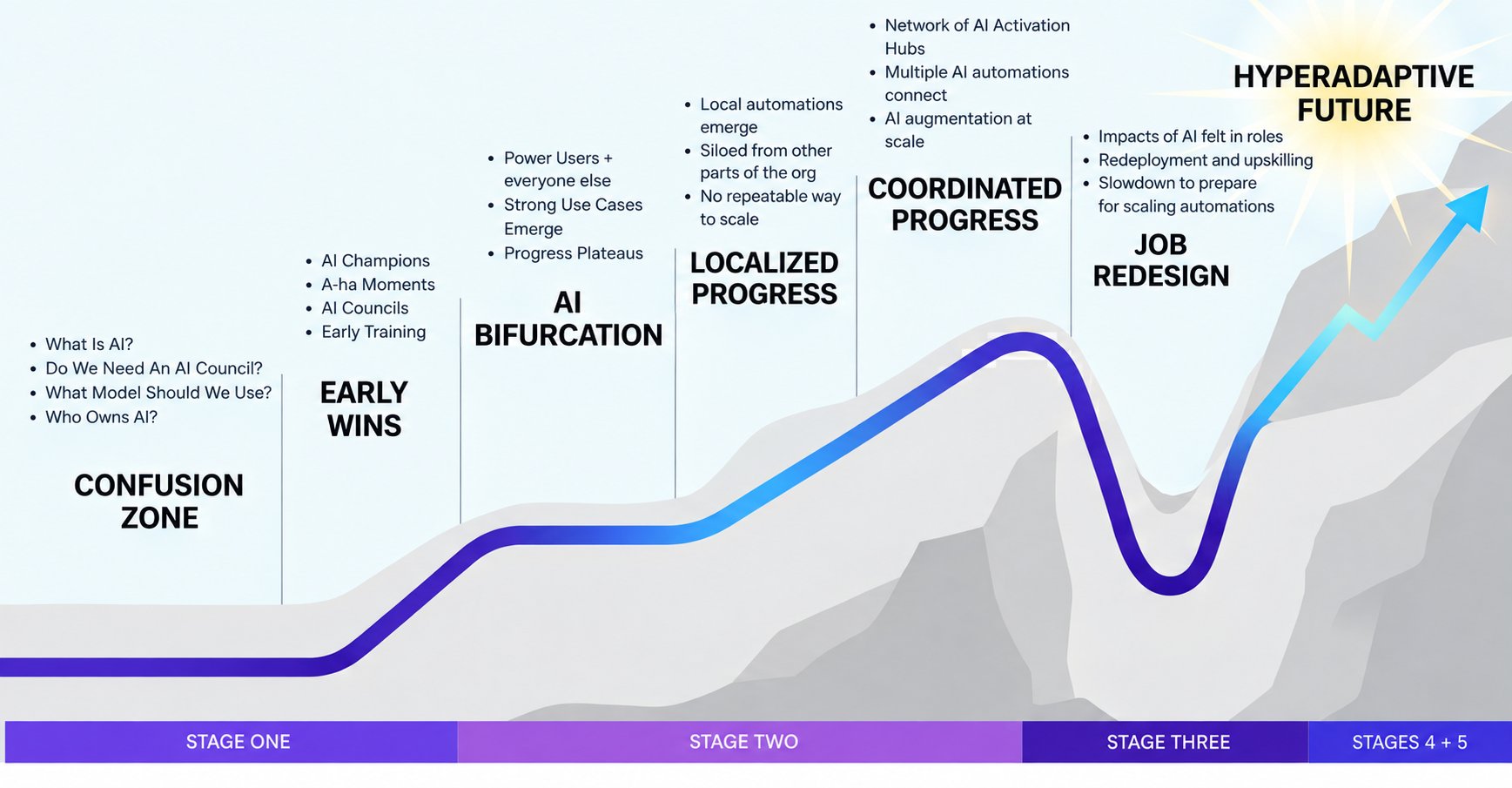
It isn't a linear checklist, but more like actual terrain. With elevation changes. With traps. With a few places where the ground looks solid but isn't.
Most organizations can identify where they are. Sometimes two people from the same organization point to different spots, which is useful information in itself.
Find your waypoint
Here's how each zone feels from the inside.
Confusion zone. This is where most organizations started in November 2022, when ChatGPT hit. They didn't know who owned AI, where it should sit in the organization, what models to use. Most organizations have moved on from this stage.
Early wins. Licenses deployed, training videos assigned, box checked. A few curious people figured things out. Real wins, real enthusiasm, but the wins are trapped in pockets. AI leads may have been named. An AI council may exist. Neither is well-supported. The terrain here is deceptively flat. It feels like progress, because there is progress. But it tends to be isolated, what I call random acts of AI.
AI bifurcation. This is the place where the majority of organizations are stuck right now. Power users have pulled significantly ahead. Everyone else is standing still, or going through the motions of using tools they don't yet trust. The gap between the people who get it and the people who don't is widening and visible. Organizations here often diagnose this as a training problem or a culture problem. It's usually neither. It's a systems and infrastructure problem.
Localized progress. Things are working, but in isolated pockets. A team, a department, a function has genuinely figured something out. The temptation here is to scale before the foundation is solid: to reach for orchestrated agents before the organization has learned how to spread simpler wins. The ambition is real and right. The support systems to spread, scale, and sustain need to be put in place.
Coordinated progress. This is where things start to feel different. The flywheel is turning. Activation hubs are forming. Learning is beginning to move across the organization instead of staying in the team that generated it. The terrain is rising and the footing is solid. Organizations here are building the systems that make progress compound.
Job redesign. As automation takes root, roles begin to shift. People start moving from doing the work to building, monitoring, and maintaining the systems that do the work. This transition is genuinely challenging and genuinely important. The unrecognized part is that it goes much better when organizations do it deliberately on a small scale before they try to do it everywhere at once.
The Hyperadaptive future. Orchestrated agents. Value stream orientation. A new operating model that the organization is capable of continuously updating because it has built the infrastructure to support it. This isn't a finish line. The horizon keeps moving. A Hyperadaptive organization doesn't arrive. It gets better at traveling. Most organizations have yet to pass into this space.
There are specific moves for each stage
Here's what I want you to take away from this map: wherever you are on this terrain, there are proven moves for getting to the next zone. Specific, research-backed executable moves that organizations have made, and that the Hyperadaptive Model is built to support. I've distilled lessons from leading organizations so you don't have to.
But first, find yourself on the map.
- The model the terrain maps to:The Hyperadaptive Model