

Why Hyperadaptive?

What if this could be your last transformation?

A transformation may change an organization, yet still not develop its ability to change.

Has your organization built the capability to continuously adapt in service of its purpose as the world around it changes?

Our Vision

A world where everyone knows they are valued, trusted to act, and that their contribution matters.

Our Mission

Enabling organizations to develop their ability to continuously adapt, in service of their purpose.

We believe the conditions under which an organization operates every day shape its ability to adapt.

Principles We Live By

We act in service of our purpose.

We connect what we do to why it matters. We don't confuse activity or output with progress. When priorities compete, we return to our purpose.

Hold us accountable: When we can't connect what we're doing to our purpose, we stop and reconsider whether we should be doing it.
We trust people to act.

We give people the context, information, and authority they need to act. Decisions are made as close as practical to the people with the knowledge to make them.

Hold us accountable: When knowledge and decision authority are separated, we ask whether that separation is intentional or simply a lingering artifact of hierarchy.

We make space for every voice.

We seek perspectives, ideas, and knowledge—not only from the most senior or familiar voices. We listen with curiosity and challenge with respect. This doesn't mean every idea is adopted or every decision requires consensus.

Hold us accountable: When we recognize a perspective is absent, we go looking for it.

We adapt as we learn.

We test assumptions, pay attention to what happens, and act on what we learn. New evidence shapes our decisions, behaviors, and systems.

Hold us accountable: When what we learn challenges what we believe or how we work, we take action.

We evolve our management and delivery systems together.

Management and delivery systems are interconnected. How strategy, funding, governance, and decisions work must evolve alongside how value is created and delivered. Improving one while leaving the other unchanged may limit the organization's ability to serve its purpose.

Hold us accountable: When one system evolves, we identify what needs to evolve in the other.

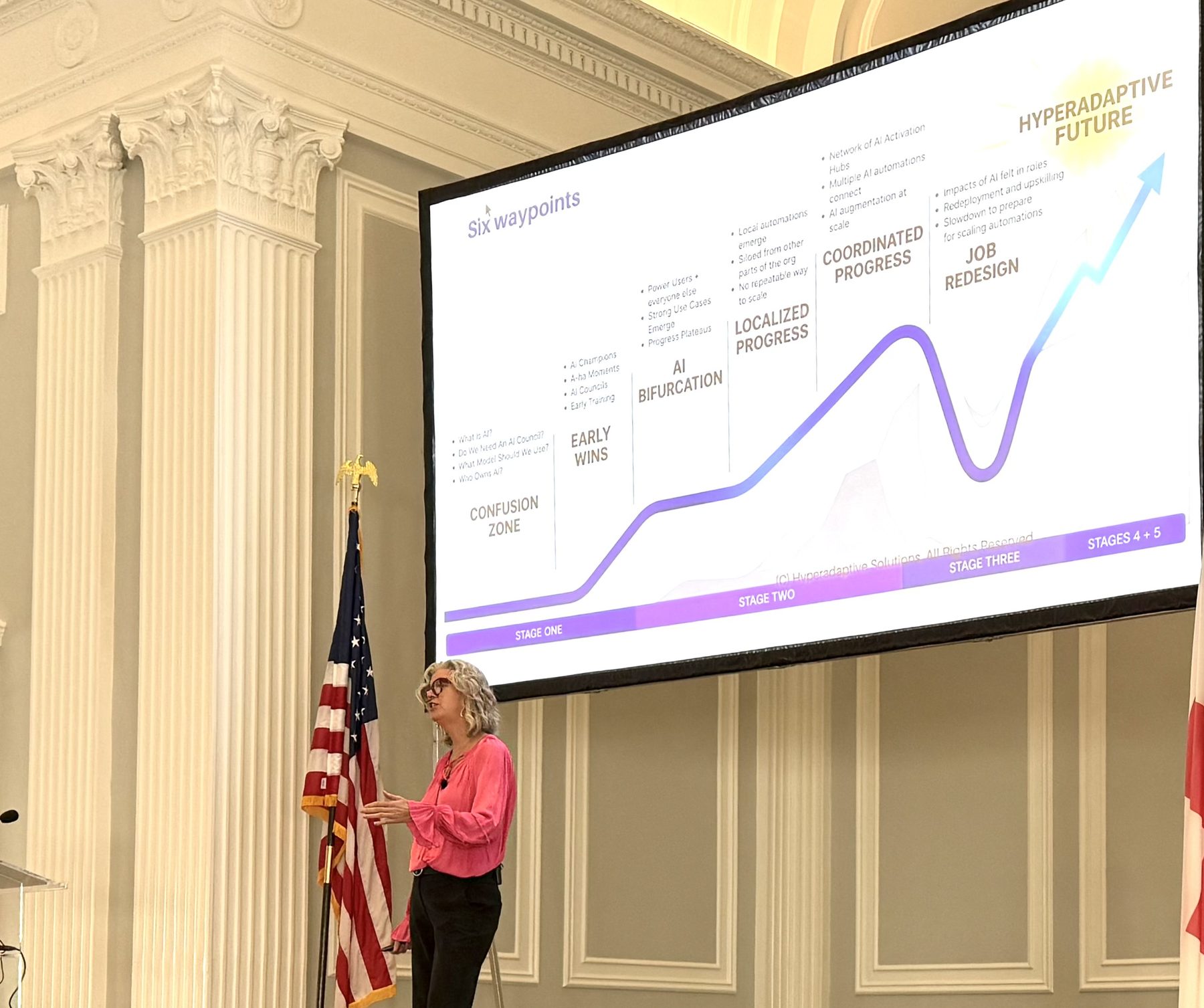
Melissa Reeve speaking on stage, the six waypoints of the Hyperadaptive Model on the screen behind her
Melissa Reeve, State of the Stack, Washington DC

The ceiling everything hit

I started out studying the Toyota Production System at Waseda University. Then Agile opened my eyes to a better way of working, one better suited to the world we live in. I co-founded the Agile Marketing Alliance to take those ideas beyond engineering, and I was the first VP of Marketing at Scaled Agile, where the work was taking them across whole enterprises.

  1. Toyota Production System (Waseda)
  2. Agile
  3. Agile Marketing Alliance (co-founder)
  4. Scaled Agile (first VP of Marketing)
  5. Hyperadaptive (2026)

And I watched the same thing happen, over and over. A team would change how it worked. The budget cycle, the org chart and the performance review stayed where they were, and the system absorbed the change. I saw it with Lean, with reengineering, with Six Sigma and with Agile. Smart people led every one of them, and each one hit that same ceiling.

the operating model: budget cycle, org chart, performance review
  1. Lean
  2. Reengineering
  3. Six Sigma
  4. Agile
Each one rose. Each one stopped in the same place.

At one job, the mantra was

"If you are awake you are working."

That is a recipe for burnout. And yet, it is all too common, especially in this country. Our systems need to change.

AI changes the work itself, in every function at once. When AI handles the tickets, the L1 role isn't there anymore. When AI drafts the contract, the junior associate's apprenticeship stops making sense. The operating model can't stay intact while the work underneath it moves. So the system is going to change.

Will it change by accident, in whatever direction the latest model release pushes it?

Or on purpose, in a direction we choose?

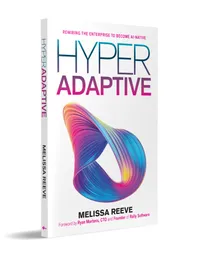
Cover of Hyperadaptive: Rewiring the Enterprise to Become AI-Native by Melissa M. Reeve

That question is why I wrote Hyperadaptive.

AI could hollow out meaningful work. It could also give people back the parts of the job that need a human. Which way it goes depends on who shows up to shape it. If you're the person in your organization who can see the operating model straining, you have company: people in your seat at other companies are seeing it too. I'm one voice in that choir.

You can start where you sit, in the role you have now. You name what's happening out loud in rooms where nobody is naming it.

Melissa Reeve

Melissa Reeve, founder.
Melissa's own site