

Where you're stuck
Who owns your AI agents?
In many organizations, nobody has decided. Agents get built fast, and the harder questions come later: who maintains each one, who's allowed to use it, what it costs, and when it retires.
The build gets easier every month. Running what you've built is where teams get stuck, and agent sprawl sets in: more agents than anyone can account for. That's an operating-model problem.
What you've built
You have people building agents, maybe dozens, maybe hundreds. Some of them save real hours. Your builders are good, and they're getting faster.
The thing most likely holding you back
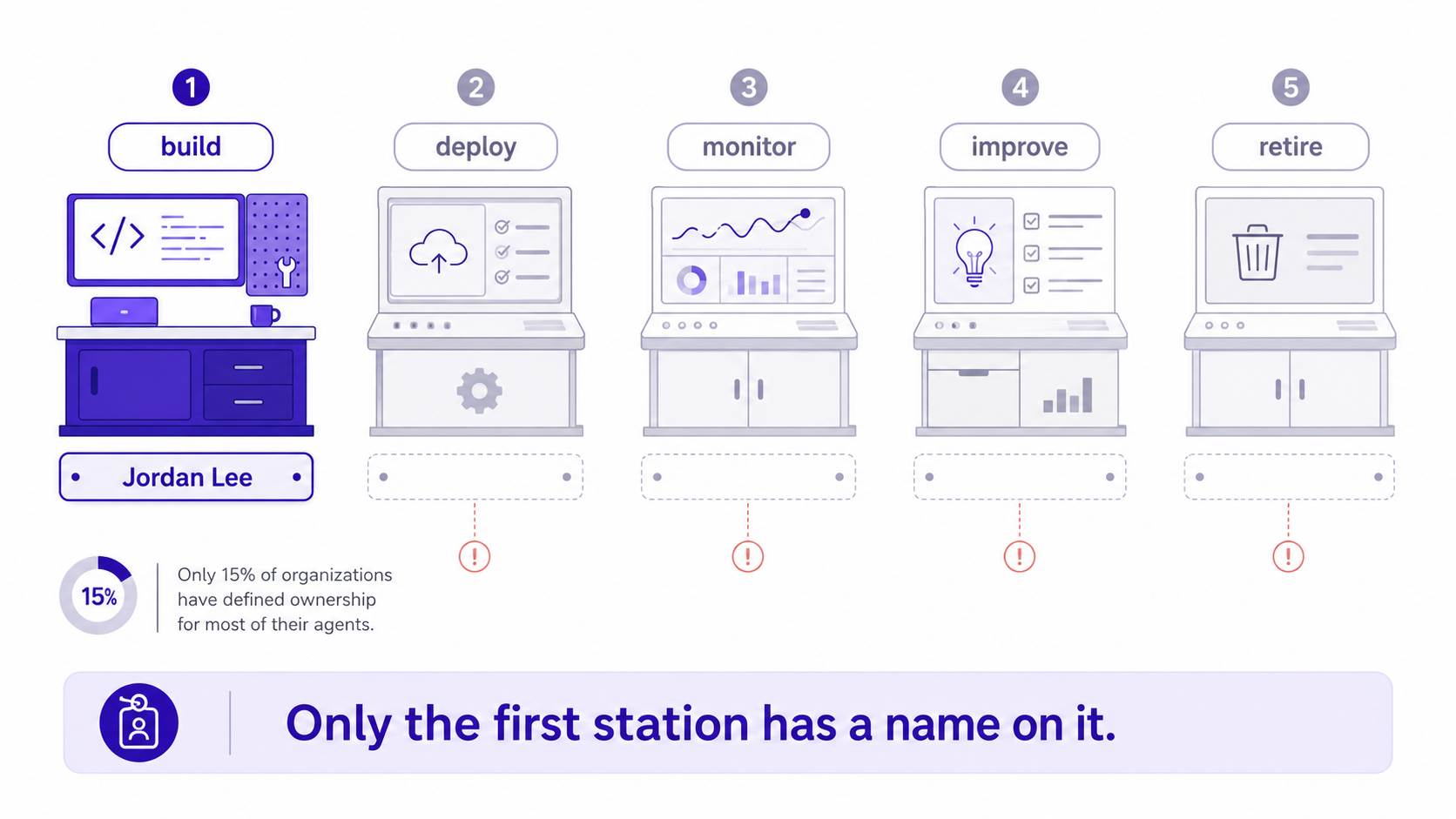
The lifecycle has no owner. When a builder changes roles, their agents keep running. Nobody's sure what each one costs, who checks its output, or when it should be shut off.
What I hear from AI leaders
Questions AI leaders are asking about their agents
When a builder leaves, who owns the agent?
What does each agent cost us to run?
Who's allowed to use it, and who checks what it produces?
A registry won't decide who's accountable
The first fix most teams reach for is a tool: a registry, a dashboard, a platform with an approval step. Those help, and you'll probably want one. A registry records that an agent exists. Deciding who's accountable when it drifts, and teaching the next team to build safely, still falls to people in each part of the business who are close enough to the work to make the call.
Hiring an outside firm to design it has a familiar risk. They set it up, they leave, and the models keep changing. Who updates the rules next quarter?
What the research says about AI agent ownership
Only 21% of organizations say they have a mature governance model for agentic AI. Source: Deloitte, State of AI in the Enterprise, 2026 (3,235 leaders, 24 countries)
More than 40% of agentic AI projects will be canceled by the end of 2027, Gartner predicts, citing escalating costs, unclear business value and inadequate risk controls. Source: Gartner, June 2025
85% of IT professionals say every AI agent has a named owner. Only 42% say that ownership is clear. Source: Ivanti research, 2026, via VentureBeat (1,500 IT professionals)
Start here
Give every agent an owner
Agents show up in a pipeline report, and most of them have nobody's name on them.
Every agent has a named owner, a known cost, a review rhythm and a retirement date, managed through the same network that spreads AI learning across the organization.
The 90-Day Activation Hub
In 90 days, your organization stands up a hub network: the roles, rhythms and decision rights that keep AI adoption moving and every agent accounted for. Your people run it when the 90 days end.
Designed by Melissa Reeve, delivered by a Hyperadaptive delivery partner.
Questions about AI agent ownership
- Who should own AI agents in an enterprise?
- Each agent needs a named owner in the business that uses it, usually the leader of the team it serves. A central group sets the guardrails, and people inside each business area apply them day to day.
- What is an AI agent lifecycle?
- It's everything that happens after the build: who can use the agent, how its output gets checked, what it costs to run, when it gets updated, and when it's retired.
- Isn't an AI governance policy enough?
- A policy sets the rules. Someone still has to apply them to each agent as the models change, and that takes people with the authority and the context to decide.
- How long does it take to set up?
- The Activation Hub runs for 90 days. Naming owners for the agents you already have comes early, so you aren't waiting until day 90 to see it working.