Speaking and research

What happens when someone from outside says it out loud?

The room stops carrying it privately and starts arguing about it together. Melissa Reeve names what AI is doing to the work, hands everyone the same words for it, and leaves the group pointed at a next step they chose themselves.

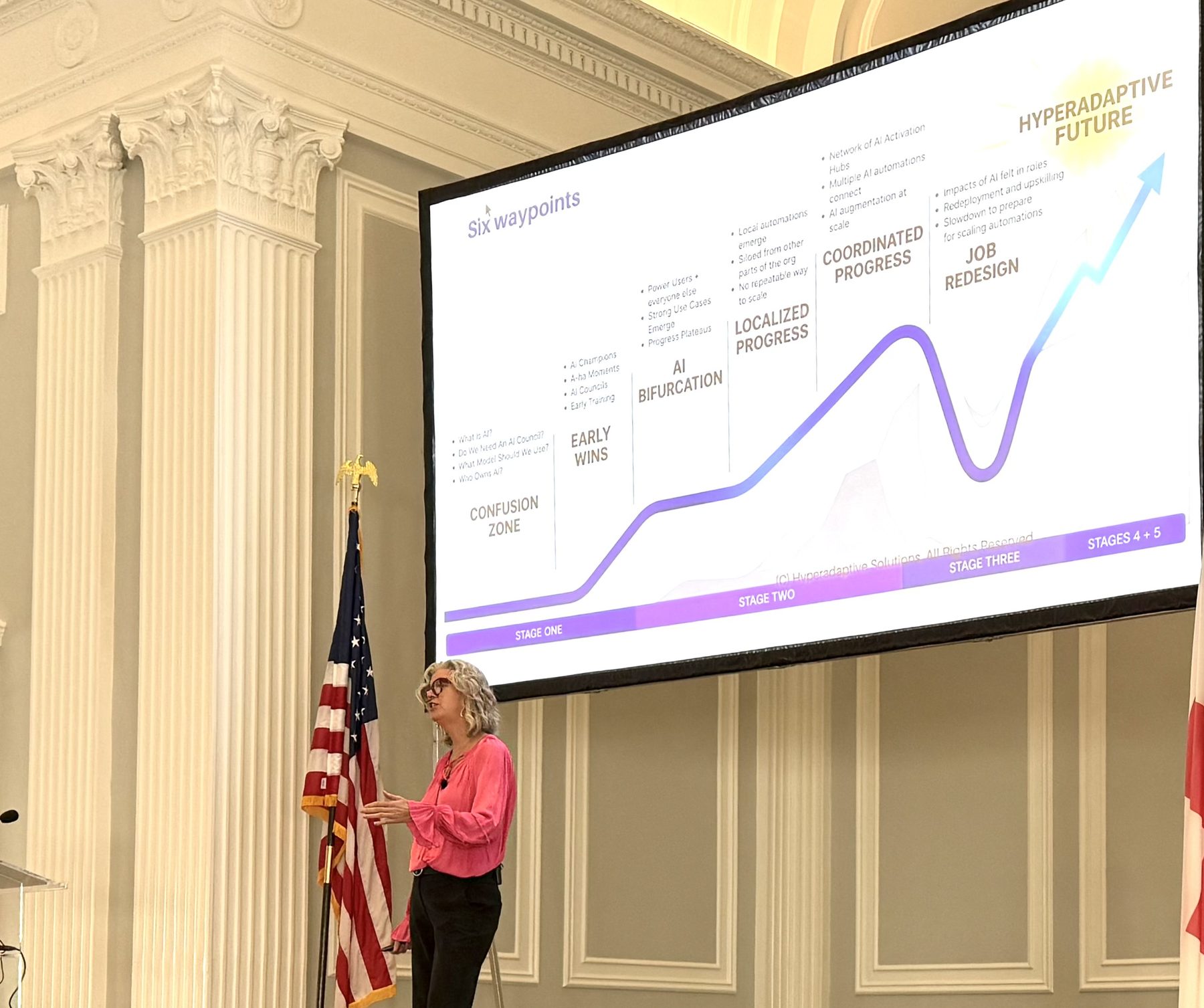
Melissa Reeve on stage at a conference, speaking to an audience with her six waypoints slide behind her.

What your audience already has

They're using the tools. Somebody in that room has already saved themselves a day a week, and two or three of them are teaching their teams on the side.

The thing most likely holding the room back

Nobody has told them what happens next. They can watch their own work change and they can't see who decides what that means for their role, their team or their budget.

Where does the hour go?

You get one hour with everyone in the same room, and at most a few of those a year. Three ways that hour gets spent.

  1. An hour of theory. The room nods along, the frameworks are sound, and nobody can apply one of them to the thing on their own desk.

  2. An hour of demos. Everyone says wow. The org chart is identical the following week, because a demo shows what the technology can do and says nothing about who in the building is allowed to decide anything.

  3. An hour where forty people hear forty different things. Each one goes back to their team with a different word for the same problem, and you pay for that in meetings for the next two quarters.

And the people wondering whether their own job survives this are in that room either way. An hour that talks past them sends them back to their desks with the same worry they walked in with.

A keynote slot is the cheapest place in your organization to give a few hundred people the same vocabulary. Every AI steering committee and every roadmap fight after it moves faster when people already share the words.

The keynote's job is to land 'I have a role to play.' Then we build on the energy of the keynote and make it actionable.
Melissa Reeve, to the SVP of HR at a global events company, planning her October keynote and the working session that follows it

The reaction I hear most often after a talk is "well, this is common sense." Of course it is! It's built on work that's been proven out for decades, with the lessons reimagined for the speed and scale of AI. People leave with names for what they've been seeing, and a next step that feels like a natural extension of where they already are.

A quarter of US workers worry their job could become obsolete

27%

Just over a quarter of US workers now worry technology could make their job obsolete. Up 7 points in a year, and roughly double the 13% who said so in 2017. Source: Gallup, September 2026 (507 employed adults, surveyed August 3 to 24, 2026)

Workers who use AI frequently are about twice as likely to fear their job will be eliminated within five years as workers who use it a few times a month. What moves that number is whether people feel their organization respects them and has a plan. Source: Gallup, September 2026 (nearly 30,000 worker observations, 2023 through Q1 2026)

Four options

Rather than presenting a finished conclusion, Melissa builds the picture with the room, live. Her first version of her cohort had four headwinds on a slide. In August she asked the room for theirs instead. Thirty-seven went up on the board, and exactly one was about the technology. Each talk runs on a framework from the book, so people leave with something they can redraw for their own organization, and a worksheet to do it with.

01

Becoming Hyperadaptive

Where are you on the AI adoption curve, and what does the next waypoint ask of you?

For
executive offsites, leadership summits, conference mainstage
The picture
six waypoints, from the confusion zone through AI bifurcation to job redesign. Most rooms place themselves one waypoint ahead of where they sit, and that argument is half the value.
They leave with:
their own read on where they are, and the AI Activation Canvas to run it with their team.

02

What AI Does to Roles

For the people who have to answer when someone asks whether their job still exists.

For
HR, people and talent leaders, CHROs
The picture
where the work is deconstructing, which rungs on the ladder are disappearing, and what a role looks like when a person moves from doing to building and monitoring.
They leave with:
a postcard from their own future, written in the room, plus the philosophy worksheet their leadership team can finish without her.

03

AI Learning is Social Learning

Your return tracks how fast people learn from each other, so the seat count is the wrong number to watch.

For
L&D, marketing, operations, transformation teams
The picture
the AI Learning Flywheel. Spark, spread, scale, sustain, and where most organizations' loop breaks.
They leave with:
the FOCUS framework for picking which use cases are worth the spread.

04

Custom

Have a different room or a different question in mind? Get in touch and we'll shape a talk around it.

Talk it through →

Every talk gets rebuilt for the room. Send the agenda, the audience and what you want them arguing about afterward, and Melissa comes back with an outline before anything gets designed. Twenty-minute opener through half-day working session, in person or virtual.

Check availability

The shape most organizers book

A keynote, then a 90-minute working session the next morning with eight to twelve of your leaders. That session is where the group picks its own first move and puts names next to it. Ask for it when you ask about dates.

Check availability

Start here

Book the talk and the room after it

Right now

The keynote lands, everyone leaves energized, and the energy has nowhere to go.

With this move

The keynote lands 'I have a role to play,' and the session the next morning turns that into a decision the group made themselves.

See her on stage

Melissa · 47 sec

Why Shared AI Responsibility Fails

Short from YouTube, plays on click

Melissa · 49 sec

How One Bank Cut an Eight-Hour Task to Three Minutes

Short from YouTube, plays on click

Melissa · 62 sec

The FOCUS Framework for Choosing AI Use Cases

Short from YouTube, plays on click
The Missing Layer, four minutes →

What organizers say

Melissa set the bar for the depth we needed to achieve. From the moment she opened the workshop, our executives understood this was a transformational change, not just another initiative or pilot.
Mariana Escalante, then Engagement Lead at Hibrids, on an agentic AI workshop for a global beverage company
Thank you for a wonderful talk. It landed very well and was the perfect addition to our workshop.
Ty Hayes, Chief Growth Officer, a global education services company
Your presentation landed really well and provoked at least an hour of lively discussion with strong engagement from everyone.
John Ford, then Senior Technology Partner at a global payments platform

That payments team left the offsite with an action to stand up AI leads, an AI council and their first activation hub.

At the education company, the CEO was referencing AI champions and asking the team to set a North Star within 48 hours.

Where Melissa is speaking

Upcoming

The calendar for the next quarter is being set now. Get in touch about your dates.

Recent

  • DC State of the Stack keynote

    September 17, 2026 · Washington, DC

Why this work

Melissa has spent 25 years watching serious people try to fix how organizations work, starting with the Toyota Production System at Waseda and running through the Agile movement, the Agile Marketing Alliance and Scaled Agile. Each one changed part of a company while the budget cycle, the org chart and the performance review carried on unchanged. AI is the first force strong enough that the operating model can't absorb it and keep going. That's the opening the book was written to name.

I'm just one voice in the choir, but I think it was important for me to join the choir.

Author of Hyperadaptive: Rewiring the Enterprise to Become AI-Native (IT Revolution Press, 2026). Research draws on cohorts of AI leaders at a global insurer, a Fortune 500 beverage company, a national logistics carrier and a global tech company.

Questions about booking Melissa

What does Melissa Reeve speak about?
The operating model AI is changing: why scattered AI wins stop spreading, what has to exist for them to add up, and what AI does to roles and the people in them. She's the author of Hyperadaptive (IT Revolution, 2026).
Does she have a talk for HR and people leaders?
Yes. "What AI Does to Roles" is built for the people who get asked whether a job still exists, and it ends with the room writing their own answer.
Does she speak virtually?
Yes, and the virtual version is built for a virtual room.
What does a keynote cost?
It depends on format, location and what the day asks for. Tell us about your event and you'll get a number back, usually within 24 hours.
How far ahead should we book?
Six to eight weeks is comfortable. Shorter turnarounds happen, so ask anyway.
Can she run a working session with our leadership team while she's there?
Often, yes, and it's what most organizers end up booking. Eight to twelve people is the sweet spot.

Check availability